Filed tariff sheets decide a charging site's biggest operating cost, and they don't read like price lists. The six fields that matter, the riders that hide in the back pages, and real examples from 86 modeled schedules.
A developer published year-one figures for a 12-stall San Diego Supercharger. Normalized to identical throughput, our tariff-derived cost of delivered power came within 1.05% of theirs — and here is exactly what that comparison does and does not depend on.
The federal charging-property credit terminated for property placed in service after June 30, 2026. What that means for sites already energized, for sites still in construction, and for the basis-reduction rule that outlives the credit itself.
Pricing a charging site at one blended $/kWh is the most common shortcut in Supercharger pro formas. Across the filed tariff library the true figure varies 8.5×, and demand charges are more than 40% of the bill in most territories.
Hardware, install, contingency, and the one-time sales tax — priced per stall and totalled for 4, 8, 12, and 20 stalls, with the state-by-state tax spread that moves the same build by six figures.
California's biggest utility bills DC fast charging through subscription blocks instead of a classic demand charge. What BEV-2-S actually charges, how the pieces interact, and what the model does with each one.
Sales tax on the build, property tax on the equipment, per-kWh excise on every sale, and percent-of-revenue levies — the four tax families a charging site pays before income tax enters the picture, with the filed rates the model carries.
Under the EV rates California utilities file, the same kWh costs 2 to 3 times more at 6 p.m. than at noon. How time-of-use windows work, what the filed spreads actually are, and what shifting ten points of load does to a year of energy cost.
A charging site sells the kWh cars receive but buys the kWh the utility meters — and the gap between the two runs through almost every line of the cost model. What the loss factor is, where it shows up, and what a 12% default does to a year of numbers.
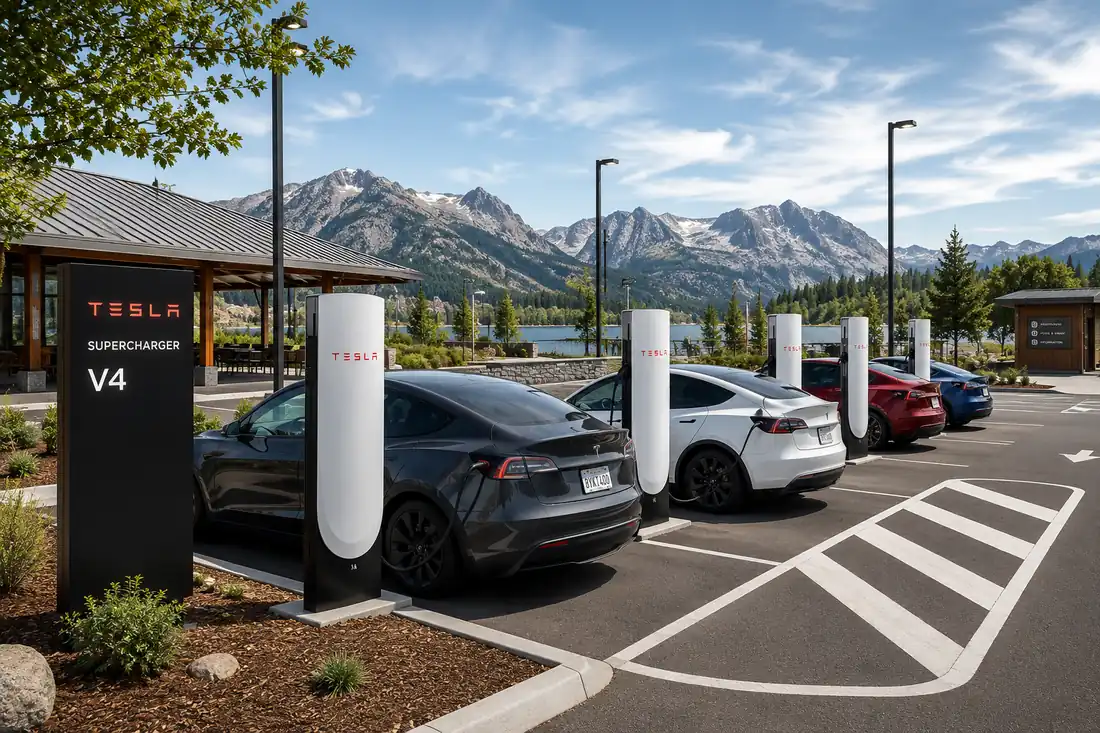
Since Tesla opened the Supercharger for Business program, property owners and businesses can purchase and own Supercharger sites. What the path from application to energization looks like, how the ownership model works, and what an eight-stall site costs and earns under the model's default assumptions.
What the national economics map shows when effective electricity cost and Supercharger density are read together: the cheapest priced territories carry single-digit station counts, and the densest territory pays close to double the cheapest.
Electricity has two prices: one for how much you use, one for your single highest 15-minute spike. For DC fast charging the second one decides the outcome — and it varies 10× by utility.
Washington, Ohio, Utah, New Hampshire, and Kentucky join the covered set — and each forced a cost the model could not express before: sales tax on installation labor, a percent-of-revenue charging tax, and a state income tax on the entity itself.
Wisconsin, Iowa, Indiana, Louisiana, and Nevada join the covered set — and the pre-seed verification pass moved real numbers in three of the five states before they shipped.
What a DC fast-charging site actually pays for demand in Montana, Idaho, Kansas, Nebraska, the Dakotas, and Wyoming — seven filed rate designs, from a plain per-kW charge to caps that erase the demand line entirely.
New Mexico, Oklahoma, Alabama, and Missouri join the covered set: five of eight new filed tariffs bill no demand charge at all, New Mexico's clean-fuels market pays the site per kWh, and Oklahoma pairs its EV rate with a 3¢/kWh charging tax.
Every cost line the underwriting engine models for a Supercharger for Business site: hardware, install, utility upgrades, electricity under 85 filed tariffs, rent, taxes, and hidden fees.