Three standard metrics, one pair of hypothetical charging sites, three different rankings. What each number actually encodes, why they diverge, and why a model reports all of them instead of picking a winner.
Filed tariff sheets decide a charging site's biggest operating cost, and they don't read like price lists. The six fields that matter, the riders that hide in the back pages, and real examples from 86 modeled schedules.
Clean-fuel credits are quoted gross, at a headline rate per kWh. Between the quote and the bank account sit an aggregator commission, a registration gap, and a payment lag that together take roughly a fifth of the line.
A grant is not a discount. It arrives mid-year, it can reduce the loan or the depreciable basis or both, and each of those choices changes the returns differently — here is how the cash flow actually treats it.
Pricing a charging site at one blended $/kWh is the most common shortcut in Supercharger pro formas. Across the filed tariff library the true figure varies 8.5×, and demand charges are more than 40% of the bill in most territories.
Hardware, install, contingency, and the one-time sales tax — priced per stall and totalled for 4, 8, 12, and 20 stalls, with the state-by-state tax spread that moves the same build by six figures.
California's biggest utility bills DC fast charging through subscription blocks instead of a classic demand charge. What BEV-2-S actually charges, how the pieces interact, and what the model does with each one.
Under the EV rates California utilities file, the same kWh costs 2 to 3 times more at 6 p.m. than at noon. How time-of-use windows work, what the filed spreads actually are, and what shifting ten points of load does to a year of energy cost.
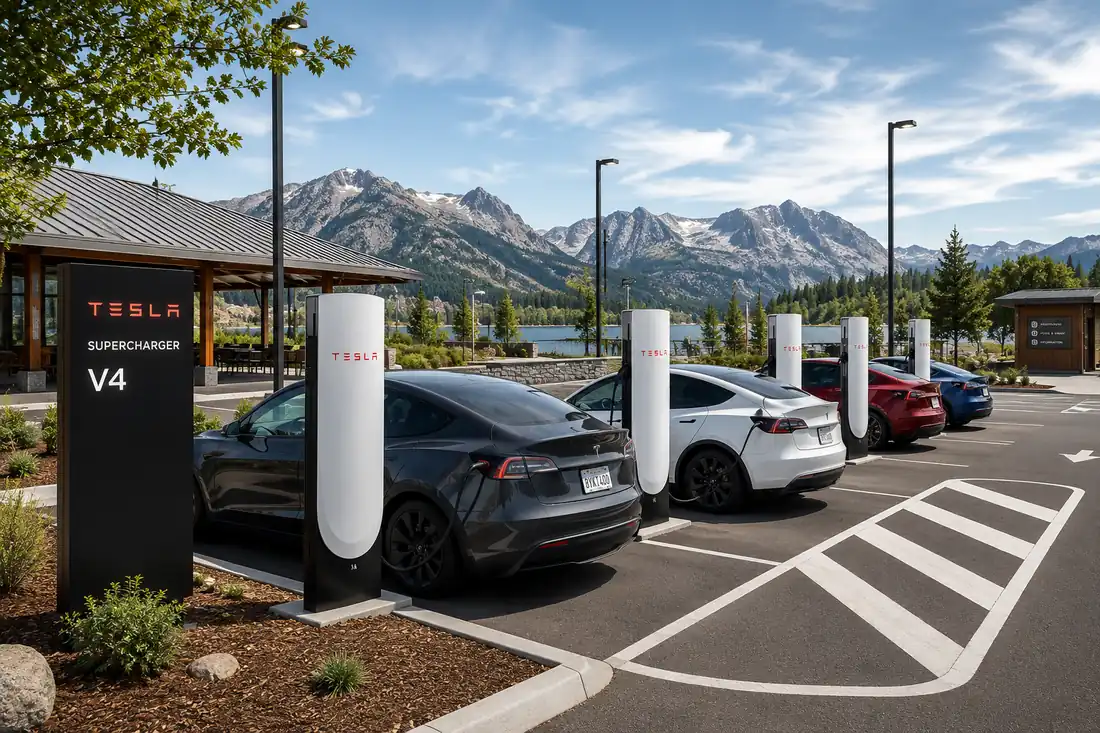
Since Tesla opened the Supercharger for Business program, property owners and businesses can purchase and own Supercharger sites. What the path from application to energization looks like, how the ownership model works, and what an eight-stall site costs and earns under the model's default assumptions.
What the national economics map shows when effective electricity cost and Supercharger density are read together: the cheapest priced territories carry single-digit station counts, and the densest territory pays close to double the cheapest.
Electricity has two prices: one for how much you use, one for your single highest 15-minute spike. For DC fast charging the second one decides the outcome — and it varies 10× by utility.
What a DC fast-charging site actually pays for demand in Montana, Idaho, Kansas, Nebraska, the Dakotas, and Wyoming — seven filed rate designs, from a plain per-kW charge to caps that erase the demand line entirely.
New Mexico, Oklahoma, Alabama, and Missouri join the covered set: five of eight new filed tariffs bill no demand charge at all, New Mexico's clean-fuels market pays the site per kWh, and Oklahoma pairs its EV rate with a 3¢/kWh charging tax.
Every cost line the underwriting engine models for a Supercharger for Business site: hardware, install, utility upgrades, electricity under 85 filed tariffs, rent, taxes, and hidden fees.